


When parents begin searching for the right preschool, one of the first things they often consider is age grouping.
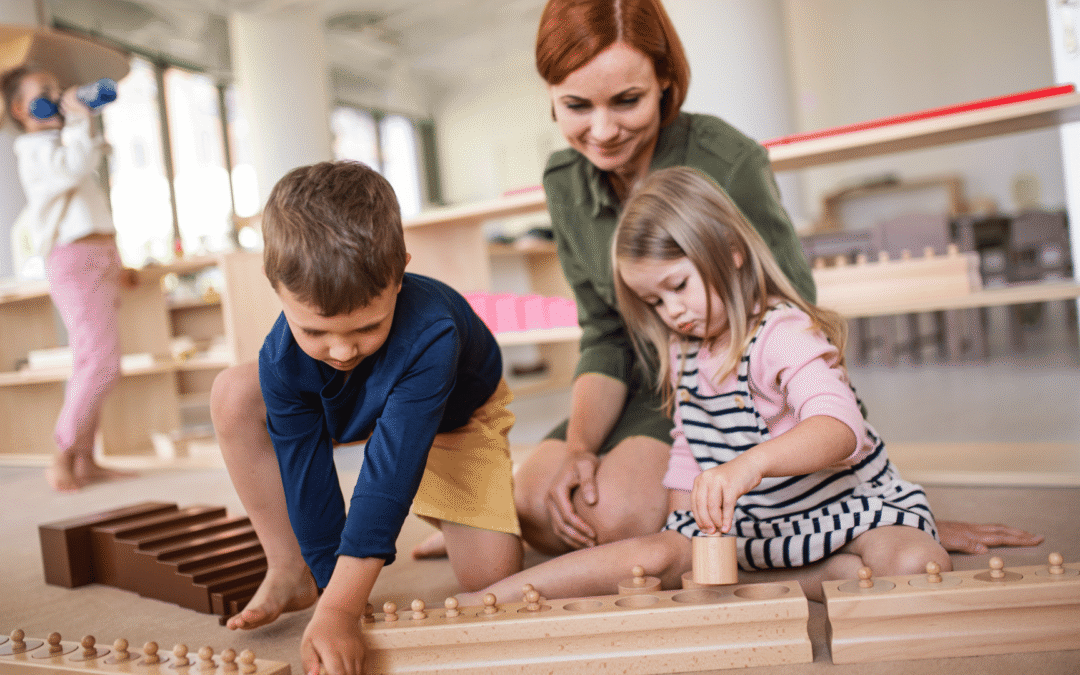
Many traditional preschool programs organize classrooms by birth year. A Montessori education takes a different approach. Instead of separating children by a single year, Montessori classrooms are intentionally designed as mixed-age classrooms where children typically learn together in a three-year cycle.
At first, this can feel unfamiliar. Parents may wonder: “Will my younger child keep up?” “Will my older child be challenged?” “Will my child learn enough in a classroom with different ages?”
The answer is yes, because mixed-age environments are not accidental. They are the most powerful parts of Montessori education. A mixed-age classroom creates a small community where children learn from each other, support one another, and develop skills that extend far beyond academics.
The Mentorship Dynamic: How Younger Children Benefit
In real life, we rarely interact only with people who are exactly our age. Families include older and younger siblings, grandparents, and relatives with different experiences and abilities. Communities and workplaces bring together people with different levels of knowledge and expertise.
Montessori classrooms reflect this natural structure. A three-year classroom cycle allows children to experience different roles over time:
- The younger child who observes and learns
- The middle-year child who gains confidence and independence
- The older child who becomes a leader and mentor
Each stage offers important developmental opportunities.
How Younger Children Benefit from Older Peers
One of the most beautiful aspects of mixed-age classrooms is the way younger children learn through observation.
Young children naturally look to others for examples. They watch how older classmates carry materials, complete challenging activities, solve problems, and interact with teachers and friends.
Imagine a toddler entering a classroom and seeing an older child confidently reading, completing a science project, or carefully building a complex structure. The younger child does not feel pressured. Instead, they feel inspired. They begin thinking “I want to try that” or “I can do that someday”.
This creates a powerful form of natural motivation. Younger children are exposed to richer vocabulary, more advanced activities, and longer periods of concentration simply by being part of the community.
This environment supports important social skills for toddlers, including communication, cooperation, patience, and observation. Children learn naturally by being immersed in an environment full of possibilities.
The Leadership Curve: How Older Children Grow
Many parents worry that older children may not be challenged in a mixed-age classroom. However, one of the greatest benefits of Montessori education is that older children deepen their learning by helping others.
When a child explains a concept to a younger classmate, something powerful happens. They must organize their thoughts, communicate clearly, and understand the idea deeply enough to share it.
Teaching becomes another way of learning. For example, an older child who demonstrates how to complete a challenging activity is strengthening problem-solving skills, communication abilities, confidence, memory, and understanding.
This leadership role creates meaningful growth. Children begin to see themselves as capable contributors to their classroom community.
Building Confidence, Empathy, and Collaboration
Beyond academics, mixed-age classrooms support emotional development.
Older children practice:
- Patience
- Responsibility
- Kindness
- Leadership
Younger children practice:
- Independence
- Asking for help
- Observing others
- Joining a community
These daily interactions help children develop empathy and strong social connections. In a world where collaboration is essential, these experiences provide valuable preparation for the future. Children learn that everyone has strengths to share and that everyone is still growing.
A Mini-Society That Mirrors Real Life
A Montessori classroom is more than a place where children complete activities. It is a small community.
Through mixed-age classrooms, children experience the natural rhythm of life: learning from others, contributing to others, and growing together. Just like in families, neighborhoods, and future workplaces, children discover that people are always at different stages of development.
This understanding builds confidence, respect, and connection. For families exploring local preschools, it is important to look beyond traditional age grouping and consider how the environment supports the whole child.
At our Montessori preschool, children are allowed to learn, lead, collaborate, and grow within a caring community. We invite you to schedule a tour and experience firsthand how our mixed-age classroom environment helps children develop academically, socially, and emotionally.
