


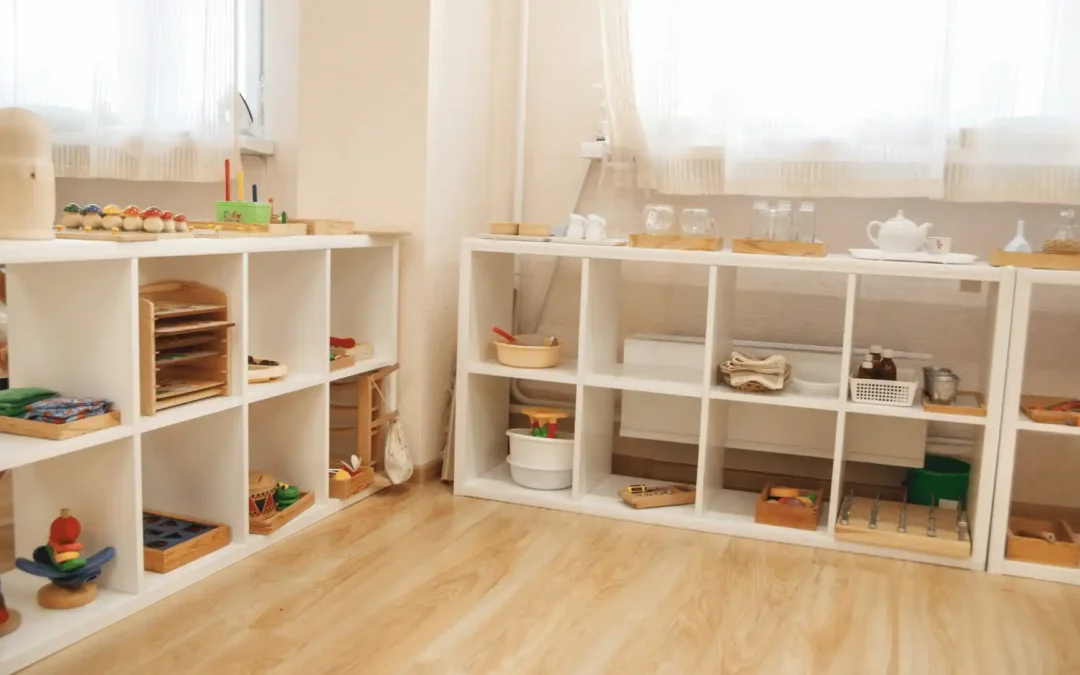
When parents first walk into a Montessori classroom, one of the first things they notice is how different it looks. No loud colors are covering every wall, no overflowing toy bins, and no chaotic rows of desks. Instead, the room feels calm, purposeful, and beautifully ordered.
At first glance, some may wonder: Why do Montessori classrooms look different from traditional preschool settings?
The answer is simple. In Montessori education, the environment itself is part of the teaching.
Dr. Maria Montessori believed that children learn best in spaces intentionally designed to support independence, concentration, and discovery. This is what we call the Montessori prepared environment, a classroom carefully organized to guide learning naturally and respectfully.
In many traditional classrooms, the adult becomes the center of instruction. In a Montessori classroom, the environment acts as the “silent teacher”. Every shelf, material, and object has a purpose.
What is a Montessori Prepared Environment?
A Montessori prepared environment is a thoughtfully designed space that encourages children to explore, make choices, and learn independently. Everything within the room is intentionally placed at the child’s level to foster confidence and autonomy. Children are not overwhelmed by excessive stimulation or distracted by clutter. Instead, they are invited into an environment where beauty, order, and simplicity help them focus deeply on their work. This intentional Montessori classroom design supports a child’s natural development while nurturing their inner motivation to learn. The environment quietly communicates: –> “You are capable.” –> “You belong here.” –> “You can do this independently.”The Importance of Order in Early Childhood
One of the most important elements of a Montessori classroom is order. Young children thrive in predictable and organized environments. During the early years, children are actively building mental structure and understanding the world around them. Consistency and logical sequencing help create security and confidence. This is why Montessori materials are arranged from:- Left to right to indirectly prepare the eyes and body for the directional flow of reading and writing
- Top to bottom
- Simplest to most complex, to allow children to build skills gradually and successfully
Purposive Play in Montessori
To an outside observer, Montessori classrooms may appear quiet or even simple. However, every activity within the environment serves a developmental purpose. This is known as purposive play in Montessori. Children are not simply “kept busy”. They are engaging in meaningful work that strengthens concentration, coordination, independence, language, problem-solving, and self-discipline. For example:- Pouring activities strengthen five motor control and concentration.
- Practical life work develops independence and sequencing skills.
- Sensorial materials refine observation and cognitive processing.
- Language materials prepare children for reading through hands-on exploration.
A Learning Environment for Toddlers that Builds Independence
Parents are often surprised by how capable young children become in a Montessori setting. In a carefully prepared learning environment for toddlers, children learn to:- Choose their own work and focus deeply.
- Return materials to the shelf independently.
- Care for their physical environment.
- Solve small problems and develop responsibility.
